The Montague Complaint

As expected, Jack Montague, the former captain of the Yale basketball team, has filed a lawsuit against Yale, citing Title IX and breach of contract concerns resulting from his expulsion for sexual assault. This case—much like the Amherst case, also handled by Montague’s lawyer, Max Stern—has the potential to be significant, though for a different reason than Amherst. Using Yale’s own data, the complaint very plausibly alleges that Yale’s Title IX bureaucrats manipulated a female student in order to bring Montague up on disciplinary charges—and that they did so to avoid the negative publicity the university was receiving for allegedly being too “soft” on sexual assault. If the complaint can survive a motion to dismiss, the internal communications from Yale’s Title IX office could make for very revealing reading.

I’ve written about this case previously; and have written on Yale extensively. (You can read the full complaint here.) The university has a long history of going after high-profile athletes through dubious procedural tactics, dating back to the Patrick Witt case.

The heart of the complaint is this: “Montague found himself thrust into the confusing, terrifying, and lonely process through which those accused of sexual misconduct are maneuvered, and into the midst of Yale’s ongoing battle to establish itself as an institution that takes accusations of sexual misconduct seriously. Unfortunately for Montague, he was a prime candidate to serve as Yale’s poster boy for tough enforcement of its Sexual Misconduct Policies: popular, well-liked and respected amongst his peers at Yale, and known throughout the country as one of Yale’s most promising men’s basketball stars. In short, imposing harsh discipline on Montague would surely make an impact.”

The basics of the case: in fall 2014, Montague had a short-term sexual relationship with a female student. In September and October, the two spent the night together three times, and had some sort of sexual contact, including intercourse on at least one occasion. On the fourth time, in October, they had sexual contact but not intercourse in a car. They then went to Montague’s room, undressed, and had sexual intercourse.

The accuser would at some point conclude the intercourse was non-consensual (when remains a matter of dispute)—that she had wanted to hook up with Montague but not have sex with him. But even by her own admission, her method of communicating this intent, as she was laying alongside Montague in his bed, was virtually non-existent. During intercourse, she said that as she kissed Montague, touching his body consensually, she also “put her hands up, pressed them against the front of Mr. Montague’s shoulders and pushed him, but not very forcefully.” She also claimed that she told Montague she wanted to hook up but not have sex, but that he gave no indication that he heard her, as they were beginning intercourse. Montague claimed the sex was consensual.

In any event, after the disputed intercourse, the accuser returned to Montague’s room later that evening; they spent the night in his bed but she told him she didn’t want to have sex. He complied. A few days later, she said she hadn’t been comfortable having sex, and they stopped seeing each other. There was no indication that he harassed her (or had anything to do with her) over the next year.

Eleven months later, the accuser’s roommate was having a conversation with a Yale Title IX official (it’s not clear how many Title IX employees Yale has—according to the most recent report, Harvard has 50, so I’d imagine Yale’s total is comparable). The roommate told the official, Angela Gleason, that the accuser had a “bad experience” with Montague. Gleason met with the accuser around a month later, but the accuser made clear she didn’t want to file charges. So Gleason suggested Yale’s Kafkaeqsue “informal complaint” process—under which Witt was charged—in which the accused student is effectively presumed guilty and can’t present evidence of his innocence. The accuser agreed, provided that she could file her complaint anonymously, since she was “not interested in having Mr. Montague punished.”

At this point comes the heart of the case. Over the next few weeks, Gleason and/or her supervisors decided that they wanted to bring up Montague on formal charges, through the University-Wide Committee (UWC). According to the complaint, they misled the accuser into (a) believing that she couldn’t keep her identity confidential; and (b) that Montague had a past history of sexual misconduct towards women.

Montague did have a disciplinary past. But according to the complaint, the matter wasn’t sexual. The incident was from his freshman year, in public, when after a night of drinking he “rolled up a paper plate from the pizza parlor and put it down the front of [a graduating senior’s] tank top.” There was no sexual discussion or skin-to-skin contact, but Yale brought up Montague on charges of sexual harassment—oddly, since no one seems to have claimed that the incident was gender-related, or was anything more than petty drunken misconduct. He was placed on probation, and fulfilled the terms.

The accuser, however, appears to have believed that Montague had committed a sexual assault—based on what she was told by Yale officials. But she still declined to file charges against Montague. So the Title IX office came up with a plan to file charges independently. The accuser said she’d testify in a hearing, to “protect other women” from what appears to have been a non-existent threat.

To bring a case against Montague under these circumstances, Yale had to violate its own procedures. According to the Spangler Reports (the twice-yearly document about sexual misconduct cases Yale files as part of its OCR settlement), the Title IX officer can file only in “extremely rare cases,” and only when “there is serious risk to the safety of individuals or the community.” After charges were filed against Montague (but before the Title IX office’s involvement was public), Spangler told the Yale Daily News, “Except in rare cases involving an acute threat to community safety, coordinators defer to complainants’ wishes.” There clearly was no acute threat to community safety” from Montague.

Once Yale chose to file charges, Montague presumably had no chance: his exoneration would undermine what appears to have been the whole purpose of filing charges against him in the first place—to prove that the university was tough on sexual assault. We’ve heard a lot in recent weeks, especially because of events at Baylor, about how athletes receive special treatment on sexual assault. And sometimes, as at Baylor, they do. But this is a case in which Montague’s status as an athlete almost certainly worked against him, by making him an inviting target for the Title IX officials in a way that a normal student wouldn’t have been. His expulsion could send a broader message.

The complaint nonetheless brings to light deeply troubling aspects of Yale’s disciplinary approach. Montague had to give an interview with the Yale investigator without being informed of the specifics of the charges against him. The accuser appears to have been prompted to prepare an opening statement at the “hearing” Yale permits; Montague wasn’t told before the hearing he could do so. He couldn’t directly cross-examine his accuser; was represented by his coach (who couldn’t speak); and had no right to exculpatory evidence. The panel—specially “trained,” but with training material the university has never revealed—found him guilty. Yale then expelled him. The panel kept no audio or visual record of its “hearing.”

In its previous statements on the case, Yale has already telegraphed one element of its defense: the Spangler reports show that not everyone accused of sexual assault is expelled, so the university procedures aren’t biased against male students (so there’s no Title IX violation), or for that matter biased at all. The complaint, however, cleverly uses this same material—along with Yale’s own sexual assault scenarios—to show that, according to its own publicly stated guidelines, Yale should not have expelled Montague. Indeed, construing his behavior in the worst possible light, according to these guidelines he should have received a reprimand.

The conclusion of the case, of course, brought a witch-hunt atmosphere that recalled memories of the early days of the lacrosse case. When the basketball players did a silent tribute of personal support, they were roundly denounced. Anonymous students placed fliers on campus deeming Montague a “rapist.” (Now that they know the specifics of the allegations, would they still agree?) The Yale Women’s Center released a public statement deeming Montague’s expulsion “progress.” Unite Against Sexual Assault Yale termed it “exceptionally disappointing to see any display of support for anyone accused or convicted [sic] of sexual assault . . . It is the responsibility of every individual in the Yale community to take an active stand against sexually disrespectful behavior and sexual assault within their organizations and social circles.” In response, the basketball players released a hostage video-like statement, apologizing.

The general points:

(1) Yale had institutional reasons for wanting a target in fall 2015, and through the roommate’s chat with the Title IX official, Yale had its target. If this case survives a motion to dismiss, the e-mails from Yale administrators could make for explosive reading.

(2) The Title IX office’s filing charges against Montague violated the criteria laid out in the Spangler Reports and in Spangler’s public statement in February 2016. Yale hasn’t explained why it was so important to go after Montague that it needed to violate its own policies.

(3) The facts (at least as presented in the complaint, which appear to be largely undisputed) suggest that Montague was innocent. But even construing them in the worst possible light to him, Yale’s own public guidelines about appropriate punishments for particular types of sexual misconduct suggested he should have received a reprimand.

The case has been assigned to a Bush I appointee, Alfred Covello. Bush I judges have been all over the lot on this question (a Bush I appointee wrote one of the worst decisions on this issue, at Cincinnati), but it was critical for Montague to avoid the district’s chief judge, Janet Hall, who wrote a pioneering decision (involving, ironically, a case at Yale) that dramatically expanded the rights of accusers and provided some of the intellectual heft for the Obama administration’s efforts to eviscerate due process for accused students.
More on the Turner Case

Stuart and I have an op-ed in the Washington Post discussing the Brock Turner case at Stanford. We argue that the case proves that campus felonies like sexual assault are better handled by the criminal justice system than by campus tribunals—in no small measure because the public can have confidence in the Turner verdict in a way that would have been inconceivable with Stanford’s notoriously one-sided campus disciplinary process. The case thus gives the lie to campus rape groups like Know Your IX and their academic supporters, such as Stanford Law’s Michele Dauber, who have attempted to delegitimize the role of the police in handling campus felonies, at least when the felony is sexual assault.

A few other points from the case that deserve a mention:

(1) The 6-month sentence imposed on Turner (along with a lifetime requirement that he register as a sex offender) has triggered a severe backlash. Given the backlash, as Jason Willick first pointed out, it’s very difficult to comprehend the far more restrained response to the 6-month sentence imposed on former Baylor football player Sam Ukwuachu. By virtually any measurement, Ukwuachu’s case (which, like Turner’s, also received extensive media attention) was more severe: the nature of his assault appears to have involved more violence; alcohol does not seem to have played any role in his crime; he seemed to have had a pattern of treating women violently; and he had no remarks comparable to Turner’s expression of remorse. Yet there was no national campaign to recall the judge in the Ukwuachu case, nor was his photograph regularly used in social media with a “rapist” theme.

It would be interesting to hear from the accusers’ rights movement, and their media and academic allies, why they responded to the two sentences so differently. (I also agree, by the way, with the inappropriateness of the recall campaign against the judge, though I consider the sentence for Turner—like the sentence for Ukwuachu—too lenient.)

(2) Before the judge issued his sentence, Michele Dauber wrote a letter to the judge demanding that Turner spend more time in jail than what the probation office recommended. Dauber said that she wrote because of her expertise on the issue—without revealing that she had previously disparaged the ability of the same prosecutor’s office that successfully tried Turner to handle campus rape cases.

In her letter, Dauber conceded (correctly) that “the facts here are in some ways especially egregious when compared with many other assaults on campus.” She cited the public nature of the crime, and the fact that Turner and his victim were strangers. Just over a page later, however, Dauber suggested that “at Stanford, assaults that are very similar to this case are unfortunately all too frequent.” [emphasis added] Really? Cases similar to public assaults of strangers are “frequent” at Stanford?

(3) In her letter, Dauber asserted, remarkably, that students who have committed sexual assault at Stanford “typically have participated in athletics.” [emphasis added] She cited no evidence for this claim. Given that the data on which such a claim could be based is confidential, Dauber either: (a) simply misled a judge; or (b) inappropriately revealed protected information. I’d bet on (a).

(4) The Stanford Law professor justified her demand for a lengthier sentence (it’s worth pausing to consider the extraordinary nature of a high-profile left-wing law professor writing a judge to demand a longer sentence for a convicted criminal than what the probation office recommended) by citing deterrence. It’s not clear why potential Stanford rapists would be deterred by seeing a classmate get a three-year sentence (plus lifetime as a sex offender, loss of a degree, loss of ability to compete as an intercollegiate athlete, and massive media exposure as a rapist) but would not be deterred by seeing a classmate get a six-month sentence (plus lifetime as a sex offender, loss of a college degree, loss of ability to compete as an intercollegiate athlete, and massive media exposure as a rapist). Dauber did not explain how she reached her deterrence evaluation.

(5) Dauber concluded by claiming that “Turner will have plenty of opportunity to finish his education.” It’s not clear what academic universe she lives in, but it’s hard to believe (and for very good reason) that many universities will accept a convicted sex criminal who has a lifetime obligation to register as a sex offender. But—much like Jared Polis in his infamous 2015 remarks—it’s critical for figures like Dauber to keep alive the myth that colleges routinely admit students found guilty of sexual assault.

Dismissing Police Investigations on Campus

In the last few months, it seems as if there’s been a new due process lawsuit every other week. (While the Chronicle closely tracks accusers’ complaints to OCR, the higher-ed media has devoted scant attention to due process suits.) As more suits have been filed, it’s become easier to identify broader trends. Two recent complaints—from halfway across the country—show universities ignoring the results of police investigations, at least when the evidence doesn’t conform to the ideological biases of the campus Title IX office.

The cases occurred at Lynn University (in Florida) and the University of St. Thomas (in Minnesota). In both instances, hookups after drinking resulted in an allegation of sexual assault. In both instances, the accuser went to the police. In both instances, the police uncovered video evidence that contradicted the accuser’s version of events. At Lynn, campus security video called into question the accuser’s claim that she was incapacitated, and therefore couldn’t have consented. At St. Thomas, campus security video contradicted the accuser’s claim that she had no romantic connections with the student she’d accuse of rape; only when police informed her of the existence of video in the campus common area did she change her story and admit the two students had been kissing. (The accused student had made this claim all along.) In both instances, in part because of the video evidence impeaching the accuser’s credibility, the allegations were deemed unfounded.

And then, in both instances, the university found the accused student guilty—in part by excluding or downplaying evidence trained law enforcement had deemed vital, and in part through almost comically one-sided procedures.

Lynn reached its result through a type of procedural chicanery. (As with a disturbing number of accusations, the Lynn case appears to have involved a white accuser making an allegation against a student of color.) During the hearing, the accused student had only a “silent” advocate (his mother), while the school allowed the accuser to be represented by counsel, who allegedly participated in the hearing. As at many schools, Lynn prohibits cross-examination of the accuser, requiring the accused student to submit questions in writing. The accused student did so—and then the panel chair refused to ask the questions, on grounds that she “already knew the answers.” Lynn found the accused student guilty, on grounds that the accuser’s having consumed alcohol rendered her unable to “fully comprehend” that she had consented. Left unexplained: (1) how the university reached a different conclusion on this point than the police, using the video evidence; and (2) why Lynn didn’t use its own standard (incapacitation, not drunkenness) for cases in which an accuser couldn’t consent.

In the University of St. Thomas case, the university briefly persuaded the judge overseeing the case to seal the complaint. A redacted version of the complaint is now available. Last December, two UST students met at a party. Both had been drinking. They flirted and returned to the accuser’s dorm. They made out on the couch in a common area. They then had some form of sexual contact in the accuser’s bathroom.

The accuser subsequently informed police that she had been sexually assaulted. In the common room, she told police, she made clear that she had no interest in intercourse with the accused student; he then asked to use her bathroom, and attacked her without warning when she went in to check on him. The police reached out to the accused student; his lawyer said the sexual contact was consensual, and that the two had made out in the common area before entering the bathroom. The police set up another meeting with the accuser, asked her about the previous interaction—and informed her that campus security video of the common area existed. She then dramatically changed her story, and admitted that she hadn’t been candid with the officers. The police interviewed a variety of other witnesses, and ultimately concluded that the “facts” and “circumstances” of the case “don’t support charges.”

The accuser, however, simultaneously pursued charges through UST. At a meeting with the accused student, his father, and his lawyer, UST’s associate general counsel dismissed the results of the police inquiry, remarking that the state “always” declined prosecution of he-said/she-said cases. The counsel then denied the accused student access to the common room video that was critical to the outcome of the police inquiry.

Under UST’s procedures, there isn’t a hearing, and therefore no cross-examination occurs. Instead, “factfinders” interview both parties, and other witnesses if necessary. No evidence exists that the accuser was asked about her shifting stories to the police. UST’s investigators found the accused student guilty, and he was suspended until the start of the fall 2017 semester. The accused student himself couldn’t see their report; his lawyer could, provided that he agreed not to make copies of it. He discovered that much of the report was redacted, weakening any chance of a meaningful appeal. UST denied the appeal—but extended the student’s suspension, without explanation, until the start of the spring 2018 semester.

Both of these cases (especially the St. Thomas one) are ambiguous; it’s possible that an assault occurred in either or even both instances. But the police appeared to have strong grounds in both cases not to bring charges. And rather than deal with the findings of trained law enforcement, both universities instead adopted procedures that limited the rights of the accused student, and removed or minimized evidence that had been critical to undermining the accuser’s credibility.

Commenting on the reaction to Baylor events, Robby Soave presciently worried “that Title IX is pushing schools in the wrong direction–away from police involvement.” The Lynn and UST cases go a step further—with OCR pressure (and administrators’ own ideological preconceptions) causing schools to undermine the results of the police investigations that occur.

Updates from Brown and Cincinnati

Beyond the hearing in the Amherst case, discussed below, two recent developments on the due process front.

The first came from Brown, where Judge William Smith entered a restraining order forbidding Brown from suspending a student its internal processes had deemed guilty of sexual assault. This is at least the third procedurally dubious case at Brown in the past two years.

In November 2014, two students hooked up while watching a movie. Based on contemporaneous text messages, the accuser had been somewhat ambivalent about the idea of sexual contact, but there was no indication of her refusing consent at the time. (Indeed, it was undisputed that: the accused student made clear he expected they’d have sex if they met to watch a movie; during the intercourse she got up to turn off the lights, before returning to the student she’d accused; and several witnesses recalled that she described the encounter as consensual.) The accuser appears to have believed the hookup might be the start of a deeper relationship with the male student; he wasn’t interested. Eleven-and-a-half months after the evening with the movie, the accuser filed a complaint with Brown claiming she was sexually assaulted. She never went to the police.

In the 2015-2016 academic year, Brown revised its sexual assault procedures—introducing more stringent definitions of consent, including a standard of “affirmative consent” and a count of “manipulation” as grounds for finding an accused student guilty. The school also moved to specially “trained” panelists (who seemed remarkably guilt-presuming). A system that already was quite biased against the accused got even less fair.

Even so, there seemed to be no grounds for finding the accused student guilty. But the Brown panelists found a way. They applied the university’s standard of consent to an incident that occurred in 2014, on grounds that the code in existence at the time of the incident did not “explicitly define consent.” In other words: the accused student was found guilty of violating a definition of consent that did not come into existence until nearly ten months after the incident for which he was accused.

Brown tried to kick the student off campus before he even had a chance to appeal this finding; the TRO allowed him to remain in place throughout the spring semester. There’s no indication what will happen once September rolls around.

—————–

Meanwhile, the opening brief has been filed to the 6th Circuit in the appeal of the University of Cincinnati case. This case, as a reminder, featured a judge ruling that it was OK for a public university not to use the presumption of innocence, and to allow an accuser to testify, and then flee the room to avoid even the limited cross-examination the university allowed. You can read the brief here.

The appeal brief raised four primary issues:

“a. The University employed a system that, viewed as a whole, failed to provide the Plaintiffs a meaningful opportunity to be heard;

b. The University required John Doe I and John Doe II to prove that they have not committed misconduct;

c. The University failed to permit John Doe I the opportunity to effectively cross-examine his accuser and failed to permit John Doe II any opportunity to cross-examine his accuser;

d. The University’s investigatory and hearing process was biased.”

It also took aim at the district court’s extraordinarily limited conception of gender bias and Title IX, noting that since adopting its current procedures, the UC had returned a guilty finding in every sexual misconduct case. In each of these cases, the accuser was a female, the accused a male.

Both cases had involved procedural improprieties that even the UC conceded; but rather than dismiss the matters as flawed, the university simply remanded the cases back based on the same information that had produced biased outcomes in the first place, and saw the original judgments confirmed.

The brief faults the district court for its hyper-technical approach to examining UC’s standards, rather than viewing the procedures as a “whole” to see the university’s basic unfairness. It also faults the district court for its reliance on an earlier 6th Circuit case (Flaim), in which the accused student was convicted of a criminal offense (relating to drugs), and thus there was no factual dispute for the university disciplinary process to resolve. And it notes the district court’s odd concession that the complaint showed UC’s process to possibly be “biased in favor of alleged victims of sexual assault and against students accused of sexual assault”—but chose to dismiss the case anyway. The allegations of bias included suggestions that UC’s Title IX coordinator had a practice of not including exculpatory information in her supposedly unbiased investigative reports.

The university will file its reply brief in just under a month.

Amherst Update

In a somewhat testy two-hour hearing earlier today, Judge Mark Mastroianni seemed inclined to allow perhaps the most important of the college due process cases—that filed against Amherst College—to proceed, though he asked tough questions of both sides, and offered a troubling comment at the very end of the hearing.

As a reminder: Amherst is the case in which the accusing student, who I’ll call A.S., withheld text messages from Amherst’s hired investigator and from Amherst’s disciplinary panel. It’s not hard to figure out why she withheld these text messages—they feature her describing the sexual encounter not only as consensual but as one that she seemed to initiate, and they also have her expressing frustration that the accused student was too drunk to come up with a convincing lie to explain the situation to their friends. When the accused student finally tracked down these texts, Amherst said it was too late to consider them, even though they eviscerated A.S.’s credibility, and he was out of luck. This decision to close itself off from pursuit of the truth, the student’s attorney (Max Stern) noted, was the “worst” aspect of Amherst’s performance in the case.

No Amherst administrator or lawyer has ever denied that these texts were exculpatory (though the college’s hired investigator appeared to do so in her deposition), and the school has struggled to offer a consistent explanation as to why the texts either didn’t appear in the hearing or were irrelevant to the outcome. In the college’s initial filings, Amherst’s attorney, Scott Roberts, appeared to blame A.S.’s roommate for failing to tip off Investigator Allyson Kurker as to the existence of the texts. In her deposition, Kurker suggested that the texts were irrelevant, since she only desires written material from accusers after the point the accuser has made a rape claim. This is a convenient way of confining her search to inculpatory evidence.

In today’s hearing, Roberts offered another explanation why the texts should be beyond the purview of the courts: they were considered by the disciplinary hearing panel, which decided that whatever inconsistencies by A.S. they showed, these inconsistencies were balanced off against the inconsistencies of the accused student’s testimony.

This argument was remarkable in three respects:

  • First, Roberts never explained how the disciplinary committee could have fairly or thoroughly evaluated texts it had never read;
  • Second, he misleadingly suggested that A.S. didn’t reference both parties to whom she texted in her hearing—she told the three non-curious panelists that she had texted a student to come over and comfort her after the “assault,” when in fact she had texted this male student to come over before her interaction with the accused student, and her purpose wasn’t comfort but to have sex with him;
  • Third, Roberts’ claim that the accused student’s testimony about recalling events earlier in the evening but not any involvement with A.S. was fully consistent with the Amherst panel’s own finding that the accused student was experiencing an alcoholic blackout at the time of the intercourse but not earlier, so his testimony wasn’t inconsistent at all. Roberts suggested otherwise by implying that the accused student’s roommate was more credible on whether the accused student was blacked out than the finding of Amherst’s own disciplinary panel.

Judge Mastroianni didn’t appear convinced by Roberts’ contention, and the nature of the text messages came up in questions he asked of both sides. In a back and forth with Stern, Mastroianni wondered whether Amherst had an explicit requirement to track down the text messages (which were, after all, the most important evidence in the case). Stern conceded that no explicit requirement existed in the Amherst code, but the expectation fell under the code’s general promise of a “thorough, fair, and impartial” investigation.

To Roberts, on the other hand, these words were window-dressing. “Thorough,” “fair,” and “impartial” mean whatever Amherst desires, he reasoned. Because the college included the language in its disciplinary code, the provisions of the disciplinary code must be thorough, fair, and impartial. (This line of argument contained an Alice-in-Wonderland quality.) It’s legally OK, Roberts later added, for a college’s “thorough, fair, and impartial” to be “biased in favor of alleged victims.” This was a rather postmodernist approach to the language of college disciplinary codes. (Disturbingly, Roberts’ bio reveals that he has overseen seminars on how universities should conduct Title IX inquiries, and has “served as independent fact finder in multiple cases involving allegations of sexual misconduct in violation of Title IX.” One can only imagine what kind of a “fair” process those accused students received.)

Fairness was a main theme of the hearing, which in many ways was focused on two dueling decisions—Judge Saylor’s recent decision in the Brandeis case, and Judge Mastroianni’s own decision in UMass. The latter was hardly due-process friendly (Roberts, by my count, mentioned it nine times, contending it “set the bar” on the issue), but also didn’t involve a claim of actual innocence. Saylor’s paean to the importance of fairness—the most important decision in favor of an accused student to date—would clearly sink Amherst, and Roberts spent considerable time attacking it. He also produced a colored chart arguing that Brandeis’ procedures were much more unfair than Amherst’s, and therefore even if Mastroianni accepted Saylor’s reasoning, it shouldn’t apply to Amherst—whose approach to the case he portrayed as characterized by “basic fairness at all times.”

On the main subject of the hearing, Amherst’s motion for a judgment on the pleadings, Roberts spoke for around 55 minutes, and had an odd tendency to misrepresent the arguments made in the accused student’s complaint. As a result, some of his responses seemed ineffective. (Mastroianni didn’t interject for significant lengths of time, so it sometimes was hard to get a sense of his thoughts.) For instance, he repeatedly insinuated that the accused student being upset or disappointed with the disciplinary panel’s decision was the primary basis for the lawsuit, and seemed not to understand the accused student’s Title IX claim—especially its claim that Amherst treated him differently than A.S. because it investigated him for sexual assault but not her, even though the disciplinary panel found that he was blacked out and thus incapable of consenting to sex. (No one denies that A.S. consented to the opening part of the sex.) Amherst’s code distinguishes between sex while drunk, in which a student can consent, and sex while incapacitated (like the accused student in this case), in which a student can’t consent. But Roberts, who argued for a strictly literal reading of the disciplinary code for the rest of his argument, urged Mastroianni to avoid what would be a “no sense” interpretation: that by writing an incapacitated student couldn’t consent to sex, Amherst actually meant that it wrote.

Other than praising Mastroianni’s decision in the UMass case and condemning Judge Saylor’s decision in the Brandeis case, a Massachusetts state case (Schaer) and a First Circuit case (Fitzgerald) were the key elements in the Amherst argument. But Fitzgerald involved allegations of sexual harassment by parents of a kindergarten student. The idea that one of the nation’s finest liberal arts colleges thinks a case involving a five-year-old indicates the appropriate level of Title IX rights for its own students is quite remarkable. And Schaer, which Amherst wanted to use for the argument that its expectations of reasonableness, not a student’s, is more ambiguous than the college’s lawyer argued, as Mastroianni pointed out in a question. He deemed the issue “frankly, . . . an important point.”

A final point, on tea leaves. Near the start of the hearing, Mastroianni twice referenced that Amherst would have the opportunity to challenge the plaintiff’s assertions at a later stage. Of course, if he dismisses the case, there’d be no later stage, so the remarks could be interpreted as suggesting he’s inclined to allow the case to move forward. On the other hand, he ended the hearing by noting that he had looked at cases with “similar concepts” in the UMass case—where he decided in favor of the university. Saylor’s Brandeis opinion hadn’t been handed down at the time of the UMass, and the issue of fairness seems to be the central one right now.

Baylor & Institutional Conflicts of Interest

In addressing sexual assault, the nation’s campuses are facing a crisis of due process. Accused students are effectively presumed guilty and are routinely denied the means with which to defend themselves.

The popular image, however, is the reverse—that of campuses awash in violent crime, with police unwilling to unfair treatment of accusers. Some of this image comes from the misleading rhetoric of demagogic politicians, such as Kerstin Gillibrand, and anti-due process groups such as Know Your IX. It also is the direct result of OCR and White House statements and actions since 2011.

But there are two truthful elements that help sustain this broader, inaccurate, narrative. First: college women are sexually assaulted in disproportionate numbers, compared to the broader population. BJS data indicates that women aged 18-24 have the highest sexual assault rate (though even among this group, higher for non-students than for students). And some percentage—no data exists on how much—of these assaults are committed by a student at the victim’s institution, the only type of cases routinely considered under the jurisdiction of campus disciplinary processes. These figures don’t in any way justify the Obama policies (championing a parallel “justice” system for college students, without any police involvement), but they do show that sexual assault has to occur at virtually any campus.

Second: there are some cases in which universities do favor the accused. (Whether colleges, rather than police, should handle such crimes is, of course, another matter altogether.) Almost all of these cases have involved allegations against men’s basketball or football players, at institutions in the Power Five (ACC, SEC, Pac-12, Big 10, and Big 12) conferences—conferences where men’s basketball and football programs mean big money for the institutions, and where alienating the sports programs can cause problems for administrators. Cases at Oregon, Michigan, Florida State, and Tennessee involved credible claims of administration favoritism of accused athletes; cases at Missouri and Notre Dame were (at the very least) far murkier.

The most prominent member of this list is Baylor, which has announced the dismissal of its football coach and the demotion of its president, Ken Starr. Problems at Baylor first attracted national attention last year, in a case involving football player Sam Ukwuachu. A jury found him guilty of rape beyond a reasonable doubt, while Baylor’s process, using the OCR-mandated preponderance-of-evidence threshold, found him not guilty.

This outcome reflects the superiority of the legal system, rather than colleges, to adjudicate serious felonies. But it’s also hard to escape the sense that—contrary to most college cases—Baylor tilted its internal processes to favor Ukwuachu.

Since then, ESPN’s Outside the Lines has devoted considerable resources to the Baylor case. (The storyline is more appealing for the network than looking into Yale’s abuse of process toward basketball player Jack Montague, it seems.) The reporting convincingly argues that Ukwuachu wasn’t a one-off case, but rather part of a systemic pattern. Perhaps appearances are deceiving, but it certainly seems as if Baylor (a faith-based institution) recruited athletes with a penchant for violence, and did little or nothing to keep its students safe. This is the sort of conduct that resulted in successful Bush-era lawsuits against Colorado, Arizona State, and Georgia. Unlike the student-on-student allegations that dominate contemporary discourse, this sort of issue seems to me a perfectly appropriate Title IX case—since university action played such a key role in bringing the rapists to campus.

In making its personnel moves, Baylor released a summary suggesting retaliation against an accusing student. Other reports indicated that the Waco Police might have downplayed crimes committed by Baylor football players. No specifics exist on either front, but both would be appropriate matters for civil lawsuits or (regarding the police, if the claims are true) possible criminal prosecution.

In coming days and weeks, we doubtless will hear from the usual suspects about how events at Baylor justify OCR’s attacks on due process, or Kerstin Gillibrand’s fear-mongering, or Know Your IX’s crusade to create a guilt-presuming atmosphere on campus. So it’s worth recalling three critical differences between events at Baylor and customary campus rape cases:

(1) Some of these accusers went to the police. Their allegations were tested, under oath and in open court, and found valid. The accused received a full opportunity to defend themselves, and were found wanting.

(2) The university—to what extent remains, I suppose, somewhat open to debate—had a campus disciplinary process that favored accused students, a situation that (outside of the athletic context at large schools) almost never happens.

(3) In at least some of these cases, the rapists never would have been on campus but for university officials actively soliciting their presence at Baylor. Ukwuachu, for instance, had been kicked off his previous football team (Boise State) for disciplinary issues. It’s hard to imagine Baylor admitting a student who simply had applied to the school with such a record. For this reason, I disagree with Dan Wetzel’s argument that Baylor’s football program shouldn’t be punished. Based on the (incomplete) information publicly available, this scandal wouldn’t have occurred but for football. So weakening football seems like a good thing.

One final point: The Baylor case provides a reminder of what everyone already knew—that in adjudicating serious felonies in which both the accuser and the accused attend the school, colleges and universities have an inherent conflict of interest. In Baylor’s, that conflict tilted in favor of the accused. But on this front, Baylor is the exception that proves the rule.

GOP Officeholders Discover OCR Overreach

Last year, Stuart Taylor and I examined the peculiar response of congressional Republicans to campus due process. Despite being elected in 2010 on a mandate against executive overreach, most congressional Republicans have remained silent or even supportive (Rubio, Ayotte, Grassley) as the administration reinterpreted Title IX to eviscerate campus due process.

The fallout from North Carolina’s HB2 has only further exposed the inconsistency of the Republican—and conservative—response to the administration’s Title IX agenda. In response to a Charlotte ordinance, HB2 prohibited all North Carolina cities from enacting anti-discrimination laws based on sexual orientation, and required transgender North Carolinians to use bathrooms, in public buildings, corresponding to their biological sex.

The first sign of this inconsistency came in a perceptive piece by Michelle Goldberg, examining the efforts of the socially conservative group Alliance Defending Freedom to defend HB2. The organization produced a video featuring a woman who described herself as a sexual assault survivor, saying she’d be traumatized by having to share a bathroom with a biological male. (HB2, of course, requires transgender men—people who look like men—to use the women’s restroom, which also would presumably have a traumatizing effect on the ADF spokesperson.) ADF’s press release added, “Advocacy groups report that, in the United States, nearly 1 in 5 women and nearly 1 in 8 high school girls have been sexually assaulted.* For many of them, the mere presence of a biological man in a women’s restroom is a trigger that causes severe emotional and mental harm—regardless of that man’s intentions.”

George Will—who among conservative commentators has distinguished himself in resisting the Obama administration’s war on campus due process—accurately deemed the figure touted by ADF as “discredited social science.” (Even Obama, as far as I know, has never claimed that 12 percent of high school girls are sexually assaulted.) ADF, for its part, has looked to preempt such criticisms through the asterisk quoted above, noting These statistics are based on studies frequently cited in mainstream media. Alliance Defending Freedom cannot vouch for the validity of the studies.”

Does ADF normally utilize statistics whose validity it can’t corroborate?

Given that the organization has spent the last few years running around the Caribbean Basin seeking to uphold sodomy laws, it’s rather hard to take seriously ADF’s current crusade for privacy. But it’s not merely ADF that’s guilty of hypocrisy here. As Goldberg pointed out, for liberals, the best response to ADF’s attacks would be to stress the importance of civil liberties (in this case, for transgender people), “rather than engaging in a victimology arms race . . . Civil libertarians know that we don’t punish people as a group for the actions of individuals. They know that in a diverse, fractious, free country, sometimes other people are going to exercise their rights in a way that upsets or even scares you. And they know that protecting civil liberties sometimes means forgoing other kinds of protection. It would be easier for people on the left to make that argument now, though, if they hadn’t spent the past few years arguing the opposite.”

In this case, it seems, the abuse of statistics and appeals to emotionalism over due process used by groups such as Know Your IX against the due process rights of accused students has been employed by ADF—for an equally illiberal end.

Last week, the federal government and North Carolina sued each other in a battle over the constitutionality of HB2. (I don’t think the state’s odds are very good.) A few days later, OCR came out with “guidance” that public schools should allow transgender students to use the bathroom of the gender with which they identify.

This approach seems correct as a matter of policy and basic human decency. But as with much of the Obama administration’s OCR record, last week’s “guidance” seems procedurally suspect. OCR released its 2011 “Dear Colleague” letter on the day the President announced his re-election, without going through a notice and comment period. For reasons that Hans Bader and Scott Greenfield have pointed out, OCR’s “guidance” seems like yet another example of the office’s overreach.

(If it’s not already clear: I oppose HB2, as well as any public school policies that don’t treat transgender students equally, including allowing them to use the bathroom of the gender with which they identify.)

So: two “Dear Colleague” letters, one targeting the rights of accused students, the other safeguarding the rights of transgender students. A principled opponent of regulatory overreach would criticize both. But if only one policy were going to be targeted, it might seem obvious that it would be the first, since the 2011 Dear Colleague letter so clearly harmed people, while the harm from the 2016 version is (at best) speculative.

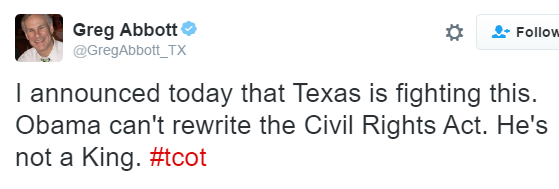
Prominent Republican politicians, however, have taken the opposite approach. There was Texas governor Greg Abbott:

Capture

And yet Abbott seems to have had no trouble with Obama acting as King, dictating disciplinary policies for Texas universities.

Governors Mike Pence and Asa Hutchinson had similar examples of selective federalism.

Perhaps the most remarkable response came from Nebraska senator Ben Sasse. He tweeted, “Has our Constitutional Law Professor-President ever read the 9th and 10th Amendments?” This is the same Ben Sasse who was president of Midland University when the 2011 “Dear Colleague” letter was issued; he remained in that capacity until his election to the Senate in 2014. There’s no indication from Midland’s sexual assault policy that Sasse had any 10th amendment concerns with a policy that targeted the civil liberties of his students.

The best-case scenario: GOP officeholders, energized by the current bathroom fight, will start looking skeptically at OCR’s earlier action. The likelier outcome, as Mark Bennett has noted: “More voters care about penises in the ladies’ room than about college boys being presumed guilty of rape.” I suspect the GOP silence regarding the administration’s assault on college students’ civil liberties will continue.

Brodhead’s Legacy

As he enters into his final year as the president of Duke Unversity, two highest-profile events of Richard Brodhead’s tenure—the lacrosse case in 2006-7, the campus protests in 2015-6—effectively illustrated his shortcomings as a leader. The most charitable interpretation of his tenure is that he was impossibly weak, a president over his head at a school like Duke and terrified by the race/class/gender student and faculty activists on his campus. The least charitable—but, I fear, more accurate—interpretation would see him as a failed leader, a model of how college and university presidents should not respond when faced with crises.

Two videos provide brief windows into Brodhead’s mindset. The first, from WRAL, came in his first public appearance—before the Durham Chamber of Commerce—after the arrests of Reade Seligmann and Collin Finnerty. By this point, his administration had declined offers from defense attorneys to examine evidence of the players’ innocence, and had remained silent amidst Mike Nifong’s pre-primary publicity crusade—a series of ethical violations that contributed to Nifong’s disbarment.

The “whatever they did” claim about Seligmann and Finnerty remains the most indefensible utterance of Brodhead’s presidency. Speaking to the city’s business and political elite, Brodhead’s remarks conveyed the impression that Duke harbored no doubts about the general media narrative of the time. (In fact, what Seligmann and Finnerty “did” was to attend a party they played no role in organizing and drank some beer.) Nearly seventeen months later, Brodhead issued an apology for intemperate remarks by the faculty. But he never apologized for, or even retracted, his statement to the Chamber of Commerce.

Indeed, in a recent interview with the Chronicle, he remarked, “I am certainly at ease with my conscience with the role that I played.” He dismissed the affair as a distraction, and denied looking back on it—an event, again, that cost his university tens of millions of dollars in settlements and legal fees—for lessons to improve his performance. The statement revealed a man incapable of critical self-reflection.

The second video, from last fall, features Brodhead sitting silent as his newly-appointed dean, Valerie Ashby, revealed a heretofore-secret policy, in which untenured faculty would be dismissed (told to “go”) if unspecified Duke administrators (or senior colleagues?) viewed them as “intolerant”:

Two Duke spokespersons didn’t respond to questions from me about the criteria for the new tenure policy, which violates core academic freedom principles. A third spokesperson gave an evasive response to Eugene Volokh.

Throughout the lacrosse case, fear remained a plausible interpretation of Brodhead’s actions—that is, that the president was so afraid of the Group of 88 that he abandoned the academy’s traditional fealty to due process. That line of argument became harder to sustain after the civil cases, when a contemporaneous Brodhead e-mail in which the president offered Primal Fear (a movie in which a guilty man fools his lawyers into believing his innocence) as a possible lens through which to interpret the accused students’ status.

Brodhead’s apparent belief in his students’ guilt perhaps explains his refusal (until after Nifong’s case already had collapsed) to defend their rights. Instead, he maintained that he had two and only two options—publicly proclaiming his belief in the students’ innocence, which would have been inappropriate; or the approach that he adopted, of issuing guilt-presuming statements that stopped just short of expressing his belief in the merits of Nifong’s case.

There was, of course, a third option, one consistent with longstanding academic principles: asserting that he couldn’t comment on the specifics of the case, but demanding that Durham authorities respect Duke students’ constitutional rights. He showed no interest in issuing such a statement. Instead, he infamously proclaimed that he looked forward to a trial, at which the accused students could prove their innocence.

Regardless of whether he ideologically shared the Group of 88’s guilt-presuming approach to the case or was simply bullied into doing so, the aftermath of the lacrosse case left Brodhead with little choice but to accommodate his race/class/gender faculty as much as possible. Group members were promoted to deanships, and there’s no indication that the administration looked at the faculty’s response to the lacrosse case as a reason to ask hard questions about Duke’s hiring priorities.

So when the protests of last fall and this spring came around, Brodhead had little choice but to appease as much as possible. Despite the absurdity of the protesters’ central claim—that a university whose leadership has spent the last two decades obsessed with increasing racial, ethnic, and gender (but not pedagogical or intellectual) diversity was actually a defender of institutional racism—Brodhead treated the protesters as serious figures. The university recently came out with a bias-response report, which doubtless will lead to hiring of more diversity-related administrators and faculty. And the president allowed the protesters to trespass in a Duke building without criminal or disciplinary sanction.

His thanks for the effort? Group of 88 extremist Wahneema Lubiano proclaiming that Duke was beset by “bigotry and exploitation.” That would be the same Wahneema Lubiano who’s now going on two decades of two purportedly “forthcoming” books.

Judge Beckwith & The Presumption of Innocence

Among the dozens of due process cases filed since the Dear Colleague letter’s appearance, the most significant factor in the outcome is the randomness of judicial assignments. Apart from a small number of cases (several, oddly, from Texas), the lawsuit cases are ones in which the college process was unfair, and the allegation was (at best) dubious. A judge inclined to find a way to produce a fair decision—Judge Dennis Saylor is the best example—will have more than enough facts with which to work.

But the general law on the question remains unclear, with precedents often dating from the period of deference, rooted in the idea that judges shouldn’t second-guess college disciplinary decisions because academics, not judges, know best what constitutes plagiarism, or what kind of conduct violates campus norms. Colleges deserve no deference in adjudicating felonies like sexual assault. But the worst decisions—Judge Abrams’ in the Vassar case, Judge Furman’s in the Columbia case—have featured judges bending over backwards to ignore the facts before them and decide for the college or university.

Last month, Senior U.S. District Judge Sandra Beckwith, a George H.W. Bush appointee, joined this undistinguished list. She heard a lawsuit filed by two accused students at the University of Cincinnati. Even in the world of university sexual assault investigations, UC’s conduct was particularly bad. The university seemed indifferent to potential exculpatory evidence (a security videotape of the dorm as the parties entered). A police detective investigating the case leveled the explosive charge that UC had tried to obstruct a simultaneous criminal investigation, apparently to bolster to accusers’ case. Both accused students were informed that neither party had the burden of proof, therefore abandoning the presumption of innocence. UC allowed one accuser to testify and then flee the room before she could be cross-examined—without then striking her testimony from the record, as basic fairness should require. The university cited a case involving a Connecticut high school student for its refusal to permit meaningful cross-examination. UC allowed the accusers to give a “victim impact statement” before the panel had adjudicated the issue—and determine which party, if either, was actually a “victim.”

None of this record troubled Judge Beckwith, who sided with the University of Cincinnati in all respects. You can read her full opinion here.

Judge Beckwith interpreted the relevant precedent as not having “clearly established that [the accused students] were entitled to the presumption of innocence,” or that they “could not be assigned the burden of proof.”

It’s true that since issuance of the Dear Colleague letter, colleges and universities have frequently presumed guilt. But they generally go through the motions of providing fairness. So it’s jarring to see a federal judge suggest that students accused of sexual assault don’t have a right to be presumed innocent. Even Judges Abrams and Furman didn’t go this far.

Judge Beckwith also offered a remarkable defense of UC’s decision to deny the accused students the right to a lawyer in the proceedings. Because UC elected to have a student life bureaucrat (who was expert in sexual assault proceedings) rather than a lawyer prosecute the case, the accused students couldn’t plausibly claim a right to an attorney. The case, this life-tenured judge added, didn’t have “unusually complex” rules. She was talking, of course, about an allegation in which (in one of the cases) an undergraduate student was forced to defend himself on a rape allegation. The Beckwith standard would provide a roadmap for schools to further weaken accused students’ rights.

According to Beckwith, none of these findings are inconsistent with her belief that “a student faced with expulsion or other discipline for violating school rules is entitled to due process before he can be deprived of his interest in continuing his education.”

In ostrich-like fashion, Beckwith concluded that “it is not reasonable to infer that UC has a practice of railroading students accused of sexual misconduct simply to appease the Department of Education and preserve its federal funding.” She only had to look across town—to Xavier—to recognize the folly of that statement.

Beckwith also dismissed the accused students’ Title IX claim, with the usual reasoning that the UC system at most was biased against accused students, and even though (as she noted in another part of the opinion) accused students are almost always male, there’s no gender component here. She also could not “conceive of an argument” that UC’s (undisputed in the record) never having found a student not guilty under the current disciplinary system suggested constitutionally problematic conduct.

Judge Beckwith leaned heavily on a 2005 6th Circuit case involving the University of Miami, which kicked out a medical school student—who was first charged for a felony drug offense and then pled guilty to a felony. The idea that public universities should be expected to give the same degree of due process to criminals as to students who were never charged with a criminal offense is bizarre.

Judge Beckwith’s conception of what constitutes “due process” is extraordinarily cramped. The students have appealed. Will the 6th Circuit agree that “due process” means that accused students aren’t entitled to the presumption of innocence?

Students vs. OCR

One of the most troubling developments of recent years–which Stuart Taylor and I first documented after the UVA case–is the emerging hostility of today’s college and university students to due process. (The recent reaction of mob-like student protesters at Yale in the Montague case is another example.) This is a breathtaking, and quite sudden, change: during the lacrosse case, the Duke student body was the voice of reason.

In this regard, it’s most encouraging to see that some students are now speaking out. Tufts student Jake Goldberg has organized a letter—currently co-signed by more than 250 undergraduates nationwide—opposing OCR’s 2016 demand for increased funding.

“We believe,” the Goldberg letter maintained, “that no further funding should be provided to this department until OCR revises its illegal and immoral guidance to our colleges and universities.” Citing events at the University of Montana, the letter chastised OCR for having “severely threatened” students’ rights to free speech. “Equally as important,” Goldberg and his fellow students maintained, the 2011 Dear Colleague letter “forced our schools to enact policies which effectively deny us of our due process rights when we are accused of violating sexual harassment policies and face disciplinary proceedings.” The student letter correctly pointed out that institutions “have responded to the mandates of OCR by establishing biased procedures with no regard to due process protections or a presumption of innocence”—and that “OCR’s guidance does not offer more security for those who genuinely need it.” In the end, the students concluded that “OCR’s guidance does nothing to protect our civil liberties; it destroys them.” The signatories promised that “we will not go away; we will no longer be silent; we will always be monitoring OCR’s actions. We as students will no longer tolerate unelected, unaccountable bureaucrats usurping our rights to free speech and due process.”

The letter, quite appropriately, has received considerable notice; its conclusions are sound, and I hope that more students sign on. In the end, only when students cease supporting (or simply tolerating) the deprivation of their rights will the current frenzy come to an end.

You can read the full letter below:

Jake Goldberg & Fellow Students

Prepared for the Subcommittee on Labor, Health and Human Services, and Education, and Related Agencies Department of Education

Dear Chairman Cochran, Vice Chairwoman Mikulski, Chairman Blunt and Ranking Member Murray:

I am writing on behalf of myself and my fellow students, whose names are listed below as a pledge of support, to express our strong disapproval for Senator Gillibrand and her colleagues’ request for $137.7 million in FY 2017 for the Office for Civil Rights of the U.S. Department of Education (OCR). We believe that no further funding should be provided to this department until OCR revises its illegal and immoral guidance to our colleges and universities.

Through its 2011 “Dear Colleague” letter (DCL), OCR has severely threatened students’ rights to free speech and due process on our college campuses. DCL fails to explicitly differentiate offensive speech from sexually harassing conduct. This was not always the case with OCR guidelines. In OCR’s 2001 Guidance, acceptance of the Supreme Court’s Davis v. Monroe delineation between free speech and sexual harassment was unequivocally stated. In 2003, OCR’s DCL once again clearly substantiated the separation between offensive expression and sexual harassment. However, these protections were lost with the issuance of the 2011 DCL, which lacked any substantial speech protective directives. This lack of safeguarding free speech enabled OCR’s 2013 Findings Letter with the University of Montana to further jeopardize our rights. This document created a broad definition of sexual harassment by defining it as unwelcome conduct of a sexual nature that does not have to be objectively offensive. Though expressed as non-binding, this definition has still been widely adopted by our campuses all across the country. By allowing vague and far-reaching restrictions on speech to be incorporated into sexual harassment policies, DCL’s directives have led to the deprivation of our constitutional and contractual rights to free speech and expression.

Equally as important is the fact that the mandates set forth in the 2011 DCL have forced our schools to enact policies which effectively deny us of our due process rights when we are accused of violating sexual harassment policies and face disciplinary proceedings. By mandating a preponderance of the evidence standard for vague and far-reaching sexual harassment codes, DCL promotes a standard of evidence that is inconsistent with the severity of alleged conduct. Colleges and universities have responded to the mandates of OCR by establishing biased procedures with no regard to due process protections or a presumption of innocence. There is no reason that sexual harassment cannot be adequately addressed and simultaneously provide all students involved with fair and balanced procedures.

We will never support codes that promote disciplinary proceedings with high risks of error, as such flawed proceedings serve the interests of neither party involved. We will never support overly broad definitions of threatening conduct, as such policies undermine those who truly suffer from deplorable acts of sexual misconduct, and result in innocent people being accused of serious violations. OCR’s guidance does not offer more security for those who genuinely need it. Its guidance allows for the punishing of those of us who hold thoughts and beliefs which others simply don’t wish to hear. Its guidance promotes biased, unfair procedures through illegal mandates that our schools are forced to adhere to. OCR’s guidance does nothing to protect our civil liberties; it destroys them. Let us be clear. Today our voices number in the hundreds, next month they will be in the thousands, and within a year we will number over a million. We will not go away; we will no longer be silent; we will always be monitoring OCR’s actions. We as students will no longer tolerate unelected, unaccountable bureaucrats usurping our rights to free speech and due process. We will not stop speaking out until our requests become our realities. Our generation has ideals and views that should rise to the stars, yet OCR’s actions leave us suffocating in the strict stripes of their red tape. For these reasons, we ask that you withhold funding for the Office for Civil Rights of the U.S. Department of Education until they change their guidelines to conform with constitutionally established principles of free speech and due process. We appreciate your consideration of this request.

Sincerely,